
There is a correlation between scientific laws of Nature and a silent similarity to your own life, as you live with an ever-beating heart.
The scientific laws of life are now derived; these laws of nature are now seen as a blueprint, teaching us how to live our lives.
The cause and effect as a formula in science can also be a formula for life.

The Scientific Laws of Life, a Mirror to Life
The scientific laws of life, as stated above, can be easily translated into what nature already whispers, that everything that we do, think, and feel is part of a greater rhythm of the Universe and its laws.
It’s as if everything happening now in your life is nothing new or the first time that it’s occurring; it’s already a part of nature, thus your life is just a reflection of the very laws of nature.
The same scientific principles that govern stars, atoms, and oceans also guide the unseen workings of human life.
The story of my life is the story that is already told through its laws.
These scientific laws are not cold or distant; they are similes. The statutes, as described, can be likened to your life as they happen.
In every law of physics lies a moral for life and philosophically, for the soul.
When we begin to see science and life as one, there is a coexistence that dates back to when the first breath of life entered the Universe.
We often think of scientific laws as confined to labs, governing planets, particles, and all living beings.
But what if they can be formulas and answers that help to govern our own lives, relationships, our personal growth, and happiness?
Imagine if the same principle that keeps the moon in orbit also influenced your habits, or the law that explains energy could clarify why your mood is contagious or life seems so disarrayed.
Let’s explore the similarities of these laws and our own lives, and how we can learn from them and apply them in our own lives; thus, we refer to them as the scientific laws of life.
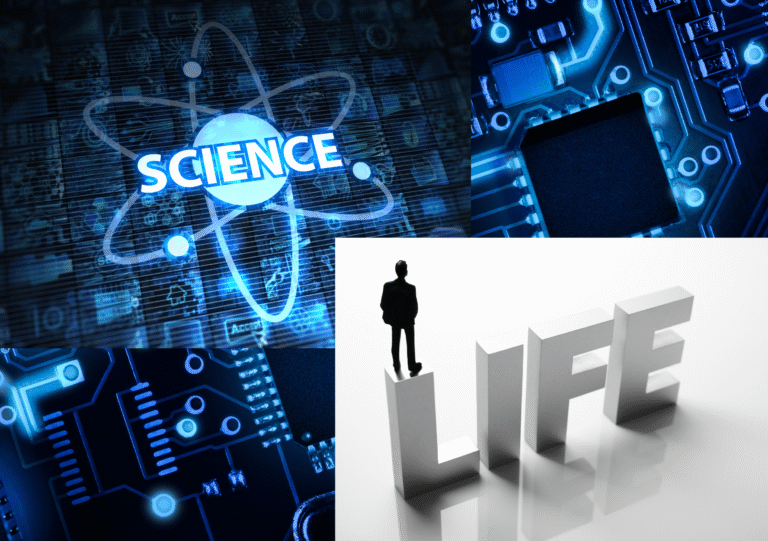
10 Scientific Laws and Principles and Its Similarities and If They Can be Applied to Your Own Life and Events.
- Newton’s Third Law of Motion
- Scientific Law: For every action, there is an equal and opposite reaction.
- Life Event Simile: The energy you put out into the world returns to you.
If you cause hurt, deception, or anger, you will eventually encounter similar negativity directed back at you.
In the same way, your kindness, support, and generosity often inspire others and life you back by treating you the same way.
“Be good to find the same coming back to you, thus your action and its reaction law at play.”
2. The Law of Conservation of Energy
- Scientific Law: Energy cannot be created or destroyed; it can only be transformed from one form to another.
- Life Event Simile: The emotional and mental energy you invest in your living days does not simply disappear or melt.
Your anxiety and worry transform into stress that harms your body.
In contrast, your effort and passion that you put into a project or life moments will be transformed into skills, results, and the respect you gain from others.
“Your ‘energy in’ will determine your ‘energy out.”
3. The Law of Gravitation
- Scientific Law: Every particle in the universe attracts every other particle with a force directly proportional to the product of their masses and inversely proportional to the square of the distance between their centers.
- Life Event Simile: You are “attracted” to and “attract” people and opportunities that resonate with your own “mass” and value, namely your character, values, and positive energy.
Further, negative influences have a weaker “pull” the more you distance yourself from them.
“You are a magnet. Become someone worth attracting, and move away from what drags you down and keeps you low in life.”
4. The Second Law of Thermodynamics
- Scientific Law: The total entropy, or disorder, of an isolated system will always increase over time, or remain constant in ideal cases.
- Life Event Simile: Friendships weaken when we stop talking.
Skills fade when we stop practicing.
Homes get messy when we stop cleaning.
To stay successful and happy, we must keep working to take care of what matters — because life naturally moves toward disorder if we don’t.”
“If we don’t keep putting in effort, things in life naturally fall apart.”
5. The Principle of Inertia (Newton’s First Law)
- Scientific Law: An object at rest stays at rest, and an object in motion stays in motion, unless acted upon by an external force.
- Life Event Simile: A person in a state of stagnation (unhappiness, lethargy, procrastination) will remain there unless a decisive force (a decision, a life-changing event, inspiration) acts upon them.
Similarly, once you build momentum toward a goal (career, fitness, and learning), it becomes easier to keep moving forward.
“If we go stagnant and lazy with life, there will be inaction and loss, but taking decisive, moving action will lead us towards success and growth.”
6. Archimedes’ Principle of Buoyancy
- Scientific Law: An object submerged in a fluid experiences an upward buoyant force equal to the weight of the fluid it displaces.
- Life Event Simile: To rise in life (to achieve success, or to overcome a challenge), you must “displace” something, usually your comfort zone, old habits, or unproductive beliefs.
“The more you push these things aside (the greater the displacement), the higher you will rise.”
7. The Observer Effect (in Quantum Physics)
- Scientific Law: The act of observing a system inevitably alters that system.
- Life Event Simile: Your perspective and focus can shape your reality.
If you constantly look for negativity and drama, you will find it, and it will be amplified.
Instead, if you choose to focus on gratitude and opportunity, you will alter your experience to see more of those moments and things as more positive in life.
“How you ‘observe’ your life, ‘changes’ your life.”
8. The Butterfly Effect (from Chaos Theory)
- Scientific Law: Small initial conditions can lead to large-scale and unpredictable variations in the future.
- Life Event Simile: A single small act, a kind word, and a single small choice in your day is like a tiny flap of a butterfly’s wings, insignificant at first, but capable of shaping the entire direction of your life.
“Small daily choices create powerful future changes — start small, and your life transforms.”
9. Pascal’s Principle (Pressure in Fluids)
- Scientific Law: Pressure applied to a confined fluid is transmitted equally in all directions.
- Life Event Simile: When you apply pressure or stress in one area of your life (e.g., overworking), that pressure doesn’t stay confined or contained.
It gets transmitted and affects all other areas, like your health, relationships, and mental well-being.
“Don’t strain life, the effect quietly spreads.
Practice balance in moments. Stay healthy and peaceful.”
10. Law of Entropy (Second Law of Thermodynamics)
· Scientific Law: Systems move toward disorder unless energy is added.
· Life Event Simile: Relationships, careers, even dreams decay if you neglect them.
“To have a beautiful life, you must put in effort, love, and attention.”

The Scientific Laws of Life: The Wisdom Whispered For Our Life
Finally, this is an invitation to conscious participation.
Now, as we live these laws as an extension or a model for our lives, naming them as Scientific Laws for life, it reminds us that we are not separate from the universe but an active, co-creating part of its grand design.
Being inspired to align our actions with these timeless principles, we can shape a reality of greater happiness, peace, and contentment in our lives.
Just as nature maintains balance through cause and effect, transformation, and constant effect, so too can we cultivate a good life by nurturing what matters and putting an end to the habits that hold us back.
The stars in the sky and the tides of the ocean should inspire us to understand that a fulfilling life is not a matter of chance but a truth that we are an extension of nature and the same forces govern all existence, including our lives.
Let these whispers of wisdom guide us in building a life that is not only worthy but deeply meaningful and resilient.
To live in accordance with these principles, as if they whisper something about life, is learning and co-create a more balanced reality.
Thus, we are an extension of the Cosmos and not a passive being in time and space.